By Alex Yankouski. AI-assisted preparation; no hands-on testing claimed. Editorial policy.
The listing has the right price, the right color and a dealership just far enough away to consume your afternoon.
Before you arrange a ride or cancel lunch, establish what you are going to see. A listing is a starting point. The useful next step is a short conversation about that exact car.
You do not need a confrontational script. You need questions that produce answers you can use.
1. Is this exact car available, and where is it now?
Include the listing link and VIN or stock number. A model name alone can send the conversation toward another vehicle.
Ask whether the car is physically at the advertised location and ready to be viewed. If it is in transit, being prepared, or at another store in the group, establish that before choosing a time.
Useful answer: “Stock 123 is at our north location and can be viewed after 2 p.m.”
Unfinished answer: “We have plenty of those. Come by.”
These are illustrative replies, not messages from a real dealership. The distinction is specificity. A helpful answer tells you which car and which destination.
2. Can you send a written, itemized out-the-door quote?
Ask for the total for your purchase location and a breakdown of the vehicle price, taxes, fees and any included products. Ask what conditions apply to advertised discounts and which items are optional. You can compare this with the other cars on your shortlist before you visit.
The FTC recommends obtaining written out-the-door prices in advance. That is more informative than comparing a headline price at one store with a monthly-payment illustration at another. FTC used-car buying guide
Keep the quote alongside the listing. If something changes, you will have a clear starting point for the discussion.
3. Can you verify the feature that makes or breaks this purchase?
Pick the one thing you cannot compromise on and ask about this vehicle specifically.
“Does it have smartphone integration?” may be too broad if you need wireless CarPlay. “Does it seat seven?” may miss whether your family can reach the third row comfortably. “Does it have a hitch?” does not establish that the vehicle and its equipment suit a particular trailer.
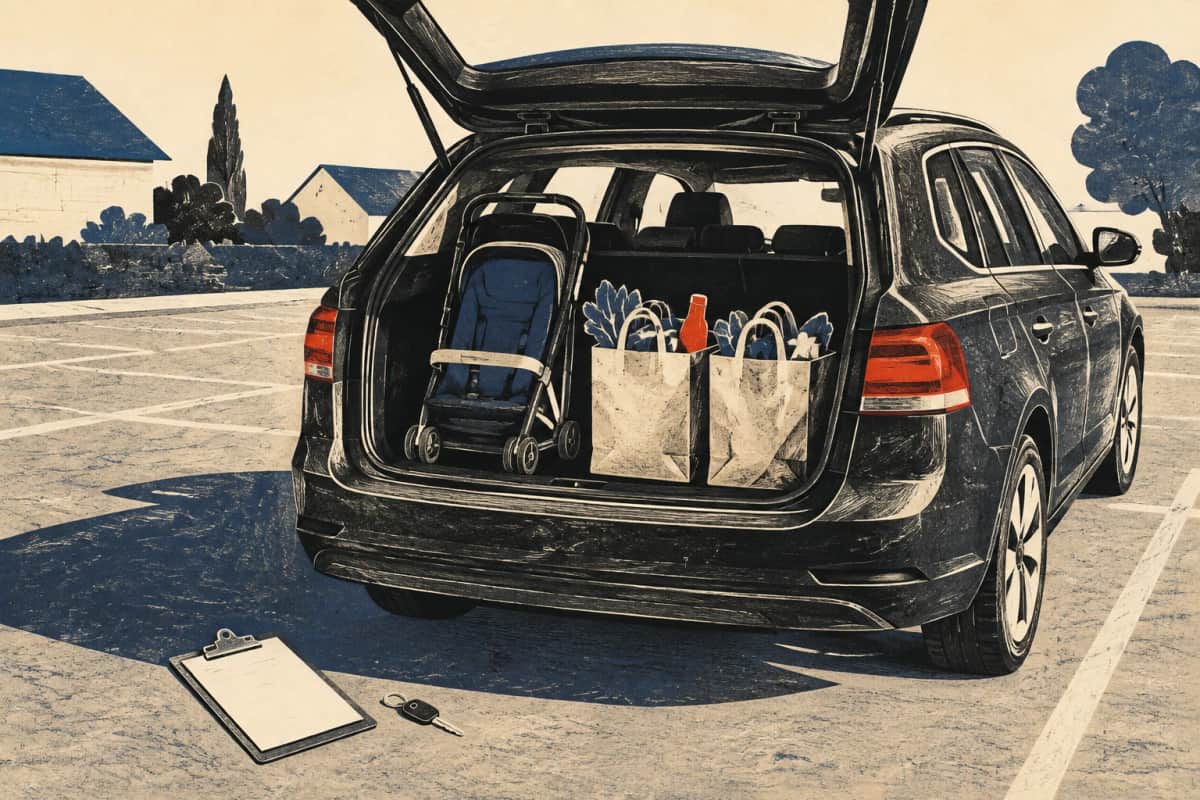
Request a photo, equipment record or other appropriate confirmation. Then plan a practical check at the visit. Bring the stroller you actually use. Measure the opening that has to fit your equipment. Sit in the seat you expect to occupy on a long trip.
The goal is to test your requirement, not to be impressed by the number of features on the page.
4. What condition information and records can I review beforehand?
Ask what documentation is available: a vehicle-history report, service records, the dealer's inspection record, or photos of disclosed damage and wear. Read what is supplied and write down what remains unanswered.
Treat the documents as separate pieces of information. A report about recorded history does not describe every aspect of the car's present condition. A photograph cannot tell you how it drives. A dealership inspection checklist tells you what the dealership says it checked.
Ask for an independent mechanical inspection before buying; the FTC recommends this even for vehicles a dealer has inspected. Agree on the logistics and cost with the dealer and mechanic. FTC guidance on inspections
5. What does the recall check show for this VIN?
For a U.S. vehicle, use NHTSA's recall lookup and ask the dealer about any result that needs attention.
A clear lookup is not a complete safety or condition certificate. NHTSA explains that the VIN search has limits: it may omit some newly announced recalls, older recalls and certain other categories. Follow up on the actual result rather than turning “zero unrepaired recalls shown” into “nothing could be wrong.”
Save the date of your check and the question you sent. If a repair is mentioned, ask for its documentation.
6. What exactly is included with this car?
Small omissions become annoying after collection. Ask about the number of keys, any equipment shown in the photos that is excluded, and any accessories you need to use the vehicle as intended.
For an electric car, for example, establish which charging cable or adapters are included instead of assuming every item in a manufacturer photo comes with a used example. You still need to verify charging compatibility for your intended setup separately.
Put the answer in your notes. “Includes two keys” is useful. “Fully loaded” tells you very little.
7. Who is confirming the visit, and what will be ready?
Ask for a named contact, the correct address, the agreed time and any requirements for the test drive. Check whether the car will be accessible when you arrive.
A submitted form does not settle all of that. Disclosure: I work on Car Handshake. On Car Handshake, your preferred test-drive time goes to the selected dealership as a request; the dealership confirms availability and timing. That distinction matters when you are planning the journey.
A message you can copy
Hello — I'm interested in the car at [listing link], VIN/stock [identifier]. Before I arrange a visit, could you confirm that this exact vehicle is available and tell me its current location? Please send an itemized out-the-door quote for my registration location, confirm [essential feature], and share the condition records available. I'd also like to discuss an independent inspection. Please confirm the keys/accessories included and whether [preferred day/time] works for a test drive. My preferred reply method is [email/phone]. Thank you.
Replace the bracketed fields yourself. This is a message template, not a request that has been sent.
The best outcome is not seven reassuring sentences. It is enough concrete information to decide whether this car deserves the trip.
Still choosing which cars to ask about? Compare current listings on Car Handshake, then contact the selected dealership when you are ready.
Publication notes
2026-09-05: Initial publication of the approved guide and original editorial illustration.
Report a correction to support@dealerhandshake.com.